
Done List vs To-Do List: What Changed When I Started Writing Tomorrow in the Past Tense
My done list vs to-do list story starts with a small difference. One is written in the future (“call the bank”), the other in the past (“called the bank”). But after a year of writing both, it stopped feeling small.
This post also exists because of a stranger on Threads. I’ll tell you about her in a moment.
What is the difference: Done list vs to-do list?
A to-do list is a list of things you still have to do. Every line is an open task, waiting for you.
A Done List is a list of things you want to get done, written in the past tense, as if they already happened. In my Done List Method, you write it before the day happens, not as a diary afterwards.
Here is the same morning written both ways.
To-do list
- Finish the report
- Call the bank
- Go for a walk
Done List
- Finished the report.
- Called the bank.
- Went for a walk.
Same tasks. Very different feeling when you read them.
5 differences I noticed in my done list vs to-do list story
These are my own observations, not scientific claims.
- Tense. A to-do list says “still to do.” A Done List says “handled.”
- Feeling. Reading a to-do list at the end of a workday, my brain starts shouting: “Half of this isn’t done!” Reading a Done List feels like closure, even when I’m still moving toward it.
- Focus. A to-do list points at what’s missing. A Done List points at where I’m heading.
- Pressure. A long to-do list can feel like a pile of debts. A short Done List feels like a direction.
- Ending. A to-do list is “finished” only when everything is crossed off, which almost never happens. A Done List works the moment you write one true line.
If you want the research angle, psychologists describe the Zeigarnik effect: unfinished tasks tend to stay in our minds. I’m not a scientist, but that matches what I felt looking at my own lists.
How I use my Done List every night
Every evening before sleep, I write my list for the next day. Sometimes it’s a normal list of tasks. Sometimes it’s just one line, like “I moved into my dream house.”
Then I do the part that matters most to me. I close my eyes, meditate, and imagine it as if I’m already living it. I feel it, I look around, I stay with the feeling. I don’t think about how it will happen. I think from the end.
This idea is close to what Neville Goddard teaches, and I explain how it connects to my method in Done List, Neville Goddard and manifestation. You can also read about living from the end.
The short story of how it started
Back in September 2025, I only earned from my day job at a printing house. I have two small children and a stressful job, and I secretly wished for some extra income doing something I enjoy. I’m a graphic technologist, and books, paper and print have always been my world.
While reading Joseph Murphy’s The Power of Your Subconscious Mind and a few other books about how the mind works, I wondered: what if I write tomorrow’s tasks in the past tense? I tried it. I felt less stress looking at the list, and my tasks still got done.
One afternoon in September 2025, around four o’clock, driving home from work, I said out loud, “calm down.” That’s how CalmDone got its name: calm and done. The full story is in How CalmDone Really Started.
Since then I’ve built this website, designed my planners, and learned to market them, all on my own. After a full year of showing up, I got my first three organic subscribers. I’m grateful to every book that got me here, and you can find them in my Calm Book Corner.
The Threads post that made me write this
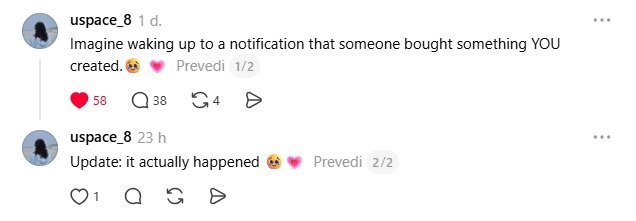
A one day ago I came across a post on Threads by @uspace_8. She wrote about imagining that you wake up and see your very first sale.
That one idea stayed with me, because it’s exactly what living from the end is about. So I did something I rarely do: I bought one of her digital products. She was so grateful that she sent me a bonus gift, and she subscribed to my website.
That small exchange showed me something. When you support another small creator, it comes back in ways you can’t plan. If you’re building something of your own, go and follow her. She’s the reason this blog post exists.
Try it tonight
You don’t need a planner to start. Use your phone or a piece of paper, and write three things in the past tense for tomorrow:
- Finished the most important task.
- Took a quiet walk.
- Felt calm when I went to bed.

Read them slowly, close your eyes, and feel them for a minute. If you’d like a place that’s built for this, my Done List Planner and the Signature Collection were designed around it.
Then come back and tell me in the comments: did your day feel different? I’d love to hear your experience.
With love, Jelena
That is my done list vs to-do list story so far. If you try it, tell me which of the five differences you notice first.