I didn’t know the history of my own method until I went looking for it.
For over a year now, I’ve been writing my tasks in the past tense before I’ve actually done them — “sent the email” instead of “send the email,” “finished the report” instead of “finish the report.” I called it the Done List™ Method, and I built an entire planner collection around it. What I didn’t realize is that the idea itself is much, much older than me — and once I traced it back, it changed how I think about manifestation, planning, and what a to-do list actually asks of your brain.
The To-Do List’s Real Problem
A to-do list feels neutral — just a record of tasks. But every unfinished line is written in a tense that keeps it open: finish, send, call, do. Nothing on that list resolves until it’s crossed off, which means your mind keeps circling back to it, over and over, all day.
A Done List does the opposite. You write the same task, but as already complete. The task itself hasn’t changed — you still have to do it — but the sentence sitting in front of you has, and that shift turns out to matter more than it should.
Where This Idea Actually Comes From
I assumed I’d stumbled onto something new. I hadn’t. The core idea — that acting or writing “as if” something is already true can make it true — has been documented, in one form or another, for over two thousand years.
Aristotle was arguably first, arguing that virtue isn’t something you think your way into — it’s something you build by repeatedly acting as though you already have it: you become brave by doing brave things, not by waiting to feel brave first.
William James, the philosopher often called the father of American psychology, formalized this in 1890 and again in 1922: instead of waiting for a feeling before acting, he argued you could “act as if” the feeling or quality already existed, and the feeling would eventually catch up. He applied it to courage and cheerfulness specifically — act as if you were brave, he wrote, and the courage tends to follow.
Neville Goddard, a mystic and writer in the New Thought tradition, took the same core idea and built an entire manifestation philosophy around it in the 1940s and 50s. His central teaching, often summarized as “living in the end,” instructs you to assume — in thought, feeling, and imagination — that your desire is already fulfilled, before any evidence of it exists. In The Power of Your Awareness, Goddard lays out this exact mechanism: think, speak, and act as though the wish is already yours, and let the outer world catch up to the assumption.

That’s the direct ancestor of what I do every morning with a Done List. Not a to-do list rewritten to sound nicer — the same underlying principle Aristotle described, that James turned into psychology, and that Goddard turned into a manifestation practice: the sentence you choose shapes the state you’re in, and the state you’re in shapes what you actually do next.
Manifestation Without the Mysticism
I want to be honest about where I land on this. I’m not asking you to believe that writing “I finished the report” makes the report write itself. What I can say, from a year of doing this daily, is that the feeling changes — less resistance, less of that low hum of pressure a normal to-do list creates — and that feeling seems to make starting easier. Whether you call that manifestation, psychology, or just a well-timed trick on your own brain, the mechanism is the same one people have been describing since Aristotle.
What This Has to Do With Planner 2027
This is exactly why I build the Signature Collection and 12 Months of Calm planners the way I do — undated, built entirely around writing the day in the past tense, not around a fixed calendar you’re supposed to keep pace with.

If you’re already thinking about your planner 2027, this is the shift worth making before you even open a new notebook: not a bigger, more detailed to-do list, but a shorter one, written as already done. I wrote more about what that actually looks like day to day in Daily Planner 2027: A Calm Way to Start Your Year.
How to Try This Tonight
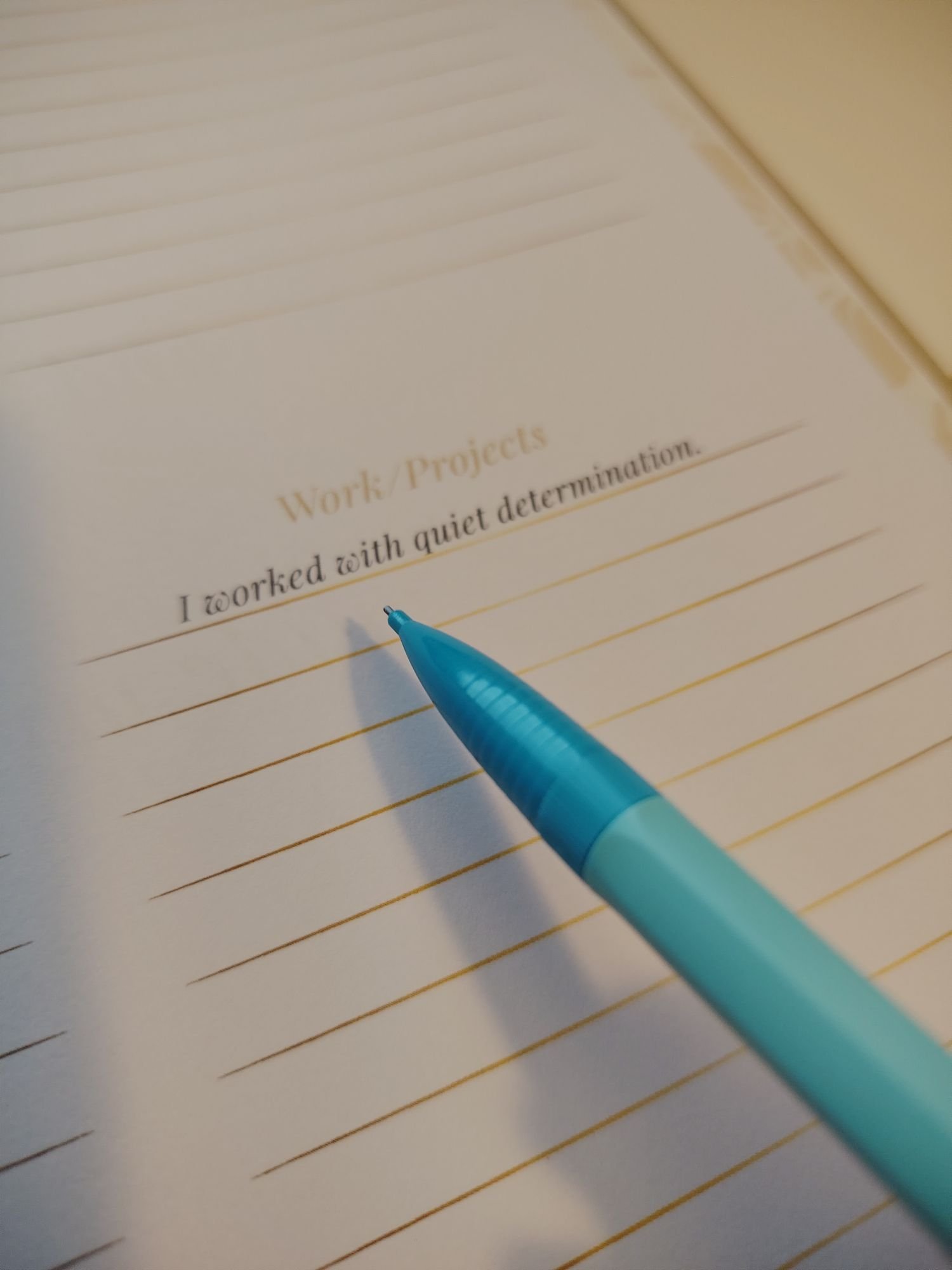
You don’t need Goddard’s full philosophy or a new planner to test the mechanism. Take three things you still need to do tomorrow, and write them as already finished:
- I sent the email I’ve been avoiding.
- I went for a walk.
- I finished the first section of the report.
None of it is true yet. Write it anyway, then go live the day underneath it. If you want to go deeper into the actual psychology behind why the tense matters — not the manifestation angle, but the well-documented cognitive one — I wrote about the Zeigarnik Effect and unfinished tasks in The Original Done List™ Method.


The Sentence Comes First
Aristotle called it habituation. James called it the “as if” principle. Goddard called it living in the end. I call it a Done List. Different names, different centuries, same mechanism: change the sentence, and the day tends to follow it.
Whatever you’re building toward in 2027, it might not need more willpower. It might just need a different tense.
With all love,
Jelena
[…] Past tense. Written before it was true, the same way I write every task I still need to do. I didn’t have a design. I didn’t have a name for it. I just had that one sentence, sitting in my notebook like a fact I hadn’t caught up to yet. If you want to understand the actual mechanics behind why writing it this way works, I go into the full history in Done List, Neville Goddard & Manifestation. […]