Efficient To-Do List vs Done List
Why an Efficient To-Do List Still Feels Overwhelming
Every day, people search for better ways to stay organized, focused, and productive.
They search for things like:
- efficient to-do list
- how to get big things done
- getting things done
- success definition
And honestly, that makes sense.

If you’ve been searching for a more efficient to-do list, you’re not alone.
Most people are not struggling because they do not care.
They are struggling because traditional productivity systems often create more pressure than progress.
That is exactly why I started thinking differently about planning, action, and the way we write our goals down.
If you have ever felt overwhelmed by your own to-do list, you are not alone.
The problem with the traditional to-do list
A classic to-do list looks helpful on the surface.
You write tasks down.
You plan your day.
You try to stay on top of everything.
But for many people, the list becomes one more source of stress.
Instead of feeling clear, they feel behind.
Instead of feeling focused, they feel scattered.
Instead of feeling productive, they feel like they are constantly catching up.
That is why so many people keep searching for a more efficient to-do list. They do not just want more structure. They want a system that helps them move forward without feeling mentally crushed by it.
Why this topic matters more than ever
What I find interesting is that this conversation sits somewhere between productivity, mindset, habit-building, and even personal identity.
Books like Getting Things Done helped popularize the idea of capturing tasks and building trusted systems for action. James Clear’s Atomic Habits focuses on small, repeatable behavior changes and identity-based habit formation. Joe Dispenza’s You Are the Placebo explores expectation, belief, and the mind-body connection. Roxie Nafousi’s Manifest presents manifestation as a practical self-development framework built around clarity, belief, and aligned action.
What all of these conversations have in common is this:
the way we think, write, and relate to our actions matters.
That is where my own method started to take shape.
What inspired my Done List approach
I did not create the Done List Method from a vacuum.
I was drawn to ideas from books and methods that talk about:
- habits
- belief
- self-image
- mental resistance
- aligned action
From Atomic Habits, I love the idea that small changes can create remarkable results. Behavior change becomes easier when it connects to identity.
From You Are the Placebo, what stood out to me was the idea that expectation affects how we experience life. Our internal state can also shape the realm of possibilities we perceive.
From Roxie Nafousi’s Manifest, I like the practical blend of clarity, self-worth, action, and trust.
But I still felt that something was missing.
A lot of productivity systems help you organize tasks.
A lot of mindset books help you believe.
A lot of manifestation content helps you visualize.
I wanted something that gently connected all three.
That is where the Done List Method came in.
The shift: from to-do list to Done List
Instead of writing everything as something hanging over my head, I started writing it as if it had already happened.
Not in a fake or delusional way.
In a calming, intentional way.
So instead of writing:
- finish work tasks
- clean the kitchen
- follow up on email
- make progress on my goals
I began writing:
- I completed my work tasks with focus.
- I took care of my home with calm energy.
- I followed up clearly and confidently.
- I made meaningful progress today.
And something changed.
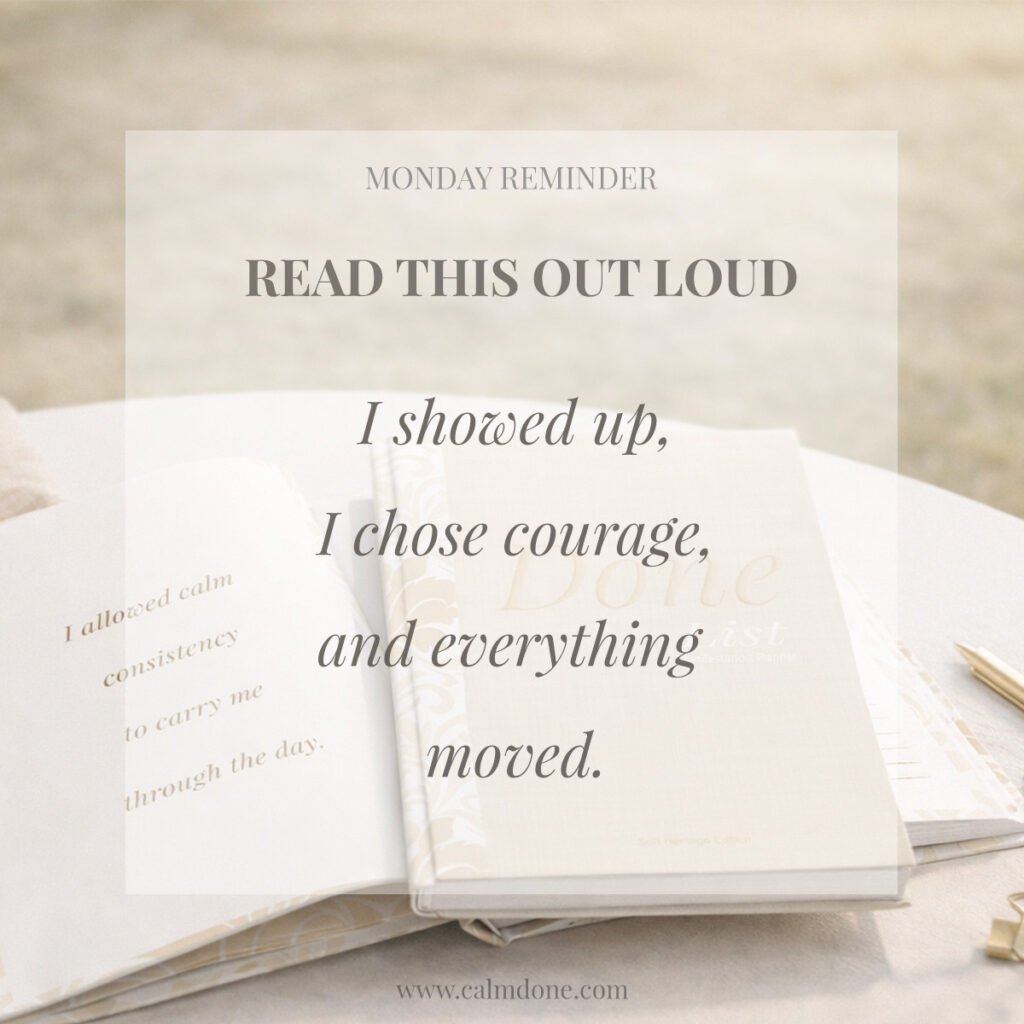
I felt less pressure.
I resisted less.
I started moving more naturally.
Why the Done List Method feels different
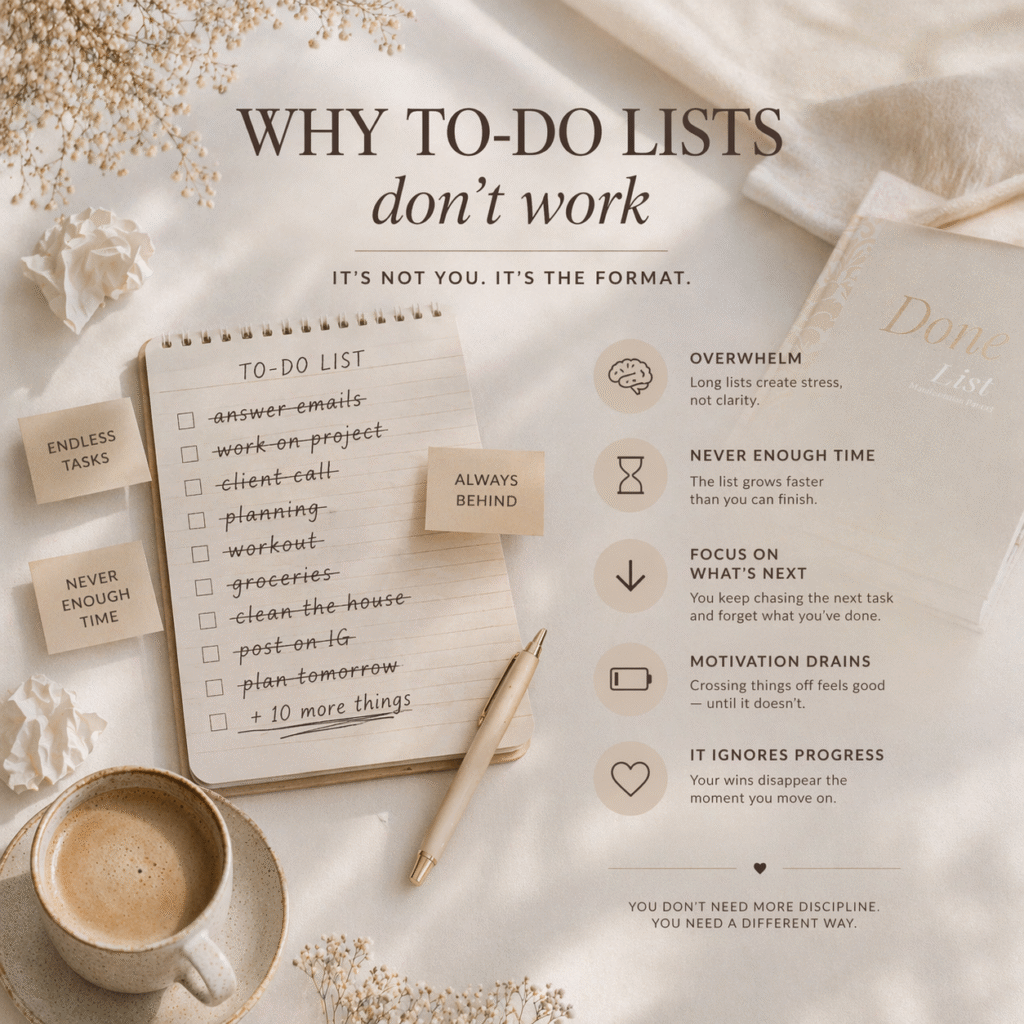
A traditional to-do list often reminds you of what is unfinished.
A Done List shifts your attention toward completion, identity, and calm momentum.
That shift matters.
James Clear writes about the importance of identity in changing behavior. This idea connects deeply with this method. When you repeatedly write, you start seeing yourself as someone who already follows through. As a result, your actions begin to reflect that more naturally.
For me, the Done List Method became a way to reduce mental friction.
It helps me stop leading with pressure and start leading with intention.
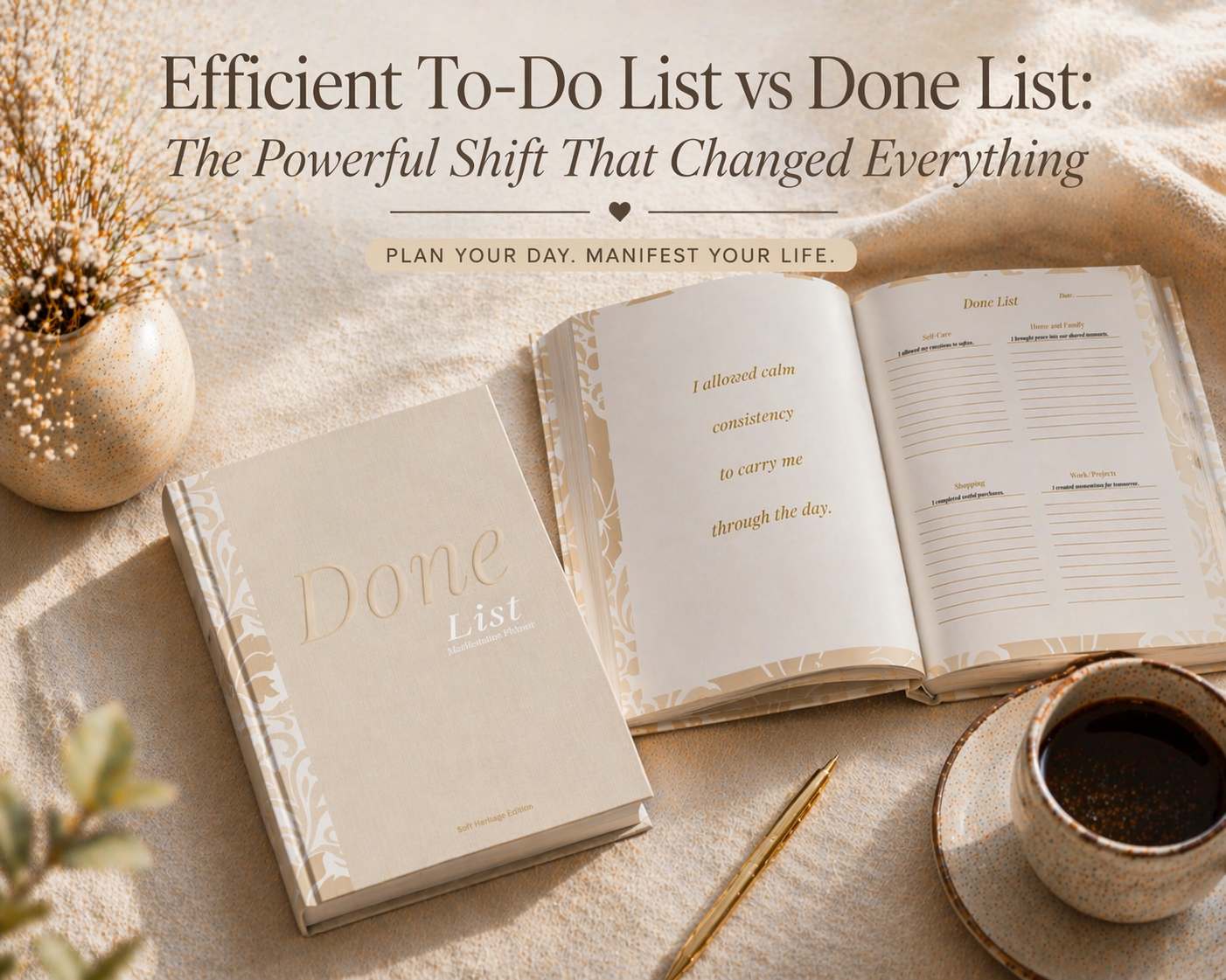
Efficient to-do list vs Done List
Traditional to-do list
- focuses on what is not done yet
- can feel heavy and endless
- often creates pressure before action even starts
- keeps many people in a loop of guilt and postponing
Done List Method
- focuses on completion and direction
- supports a calmer internal state
- makes action feel more natural
- reinforces the identity of someone who follows through
This is why I do not see the Done List as just a cute productivity trick.
I see it as a mindset tool.
Where the Signature Collection fits in
This exact philosophy is built into the CalmDone Signature Collection.
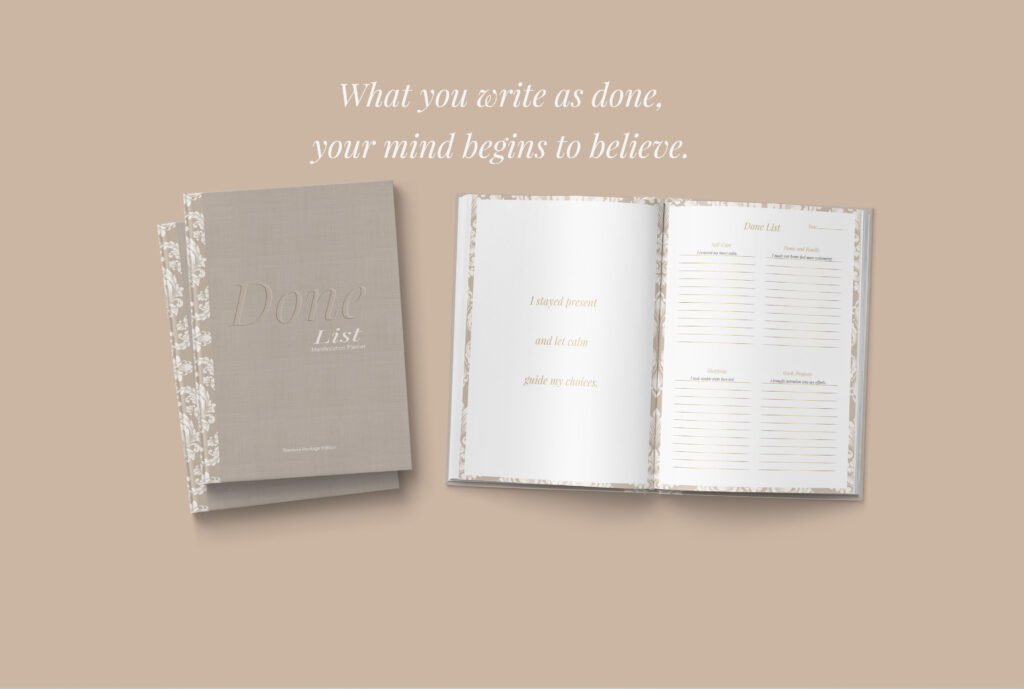
The Signature Collection was not created to be just another planner with boxes and checklists. It was designed to support a softer but still powerful way of planning. This method blends productivity, calm, self-trust, and daily forward movement.
If traditional planners feel rigid or stressful to you, the Signature Collection offers a more intentional alternative. It provides a space where planning meets mindset. Here, getting things done does not have to feel harsh.
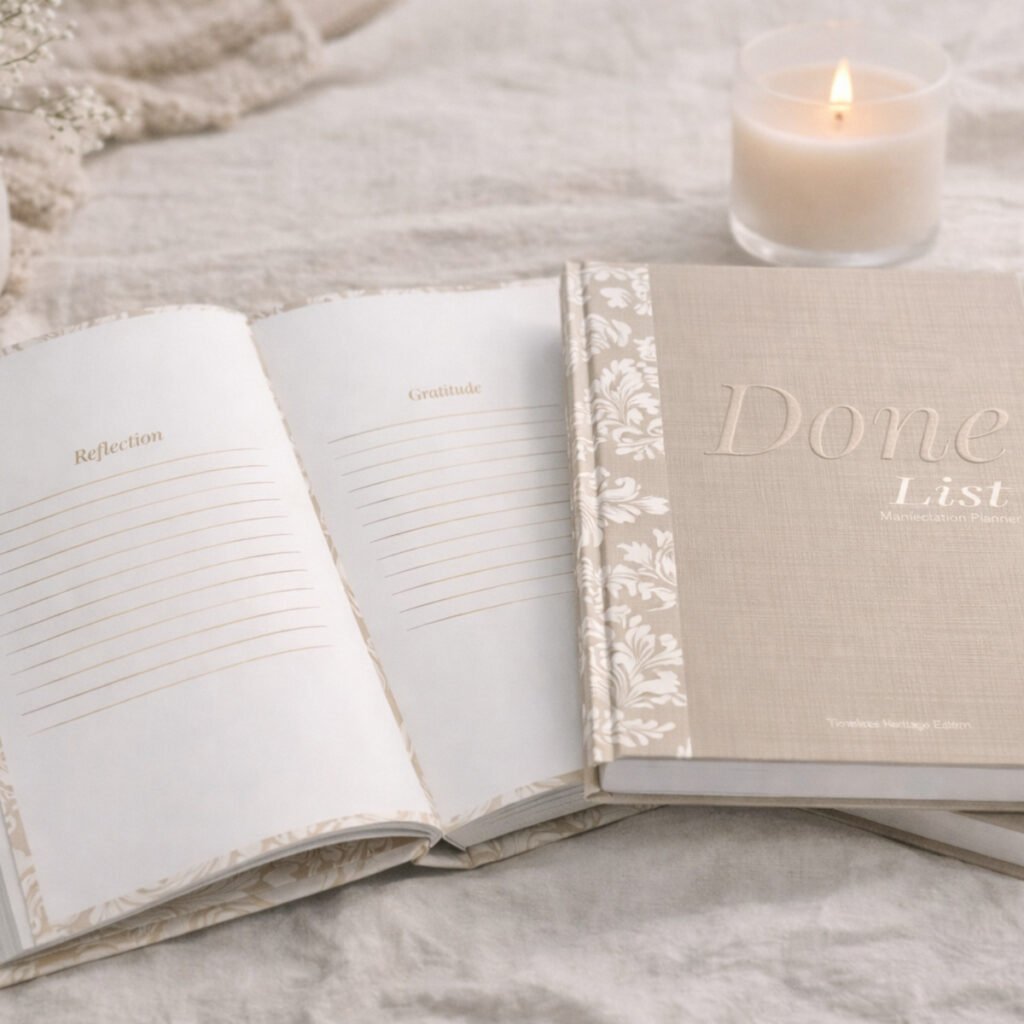
This is also why the Done List Method belongs inside a planner.
Because the right planner should not just hold your tasks.
It should support the way you want to feel while living your life.
This is not about pretending. It is about direction.
I want to be clear about something:
The Done List Method is not about ignoring reality.
It is not about sitting still and hoping life changes by magic.
It is about shifting your language so your mind experiences action differently.
For me, that makes a real difference.
It helps me feel grounded.
It helps me act with less resistance.
And it helps me return to a calmer version of productivity — one that feels more sustainable in real life.
A better definition of success
I think this also connects to something bigger: how we define success.
For a long time, success was sold to us as constant pushing, endless hustle, and never being satisfied.
Now, more people are questioning that.
Maybe success is not just doing more.
Maybe success is doing what matters with more clarity, more peace, and more self-trust.
That is the energy behind CalmDone.
And that is the reason I believe the Done List Method resonates with so many people.
Try this today
If your current system feels heavy, try this small shift today.
Instead of writing:
- send that email
- clean the house
- work on my project
- stay consistent
Write:
- I sent the email clearly and confidently.
- I brought calm back into my space.
- I moved my project forward.
- I stayed consistent with what matters.
It is a small change in wording.
But sometimes small changes create the biggest inner shift.
You Read Every Word — And Something Changed
You may not need a more complicated system.
You may simply need a more supportive one.
That is why I believe the future of productivity is not just efficiency.
It is calm efficiency.
And that is exactly what I want CalmDone to stand for.
If you want to explore this approach further, you can start with the Signature Collection. You can also read the blog posts behind the CalmDone philosophy.
Consider it done.