
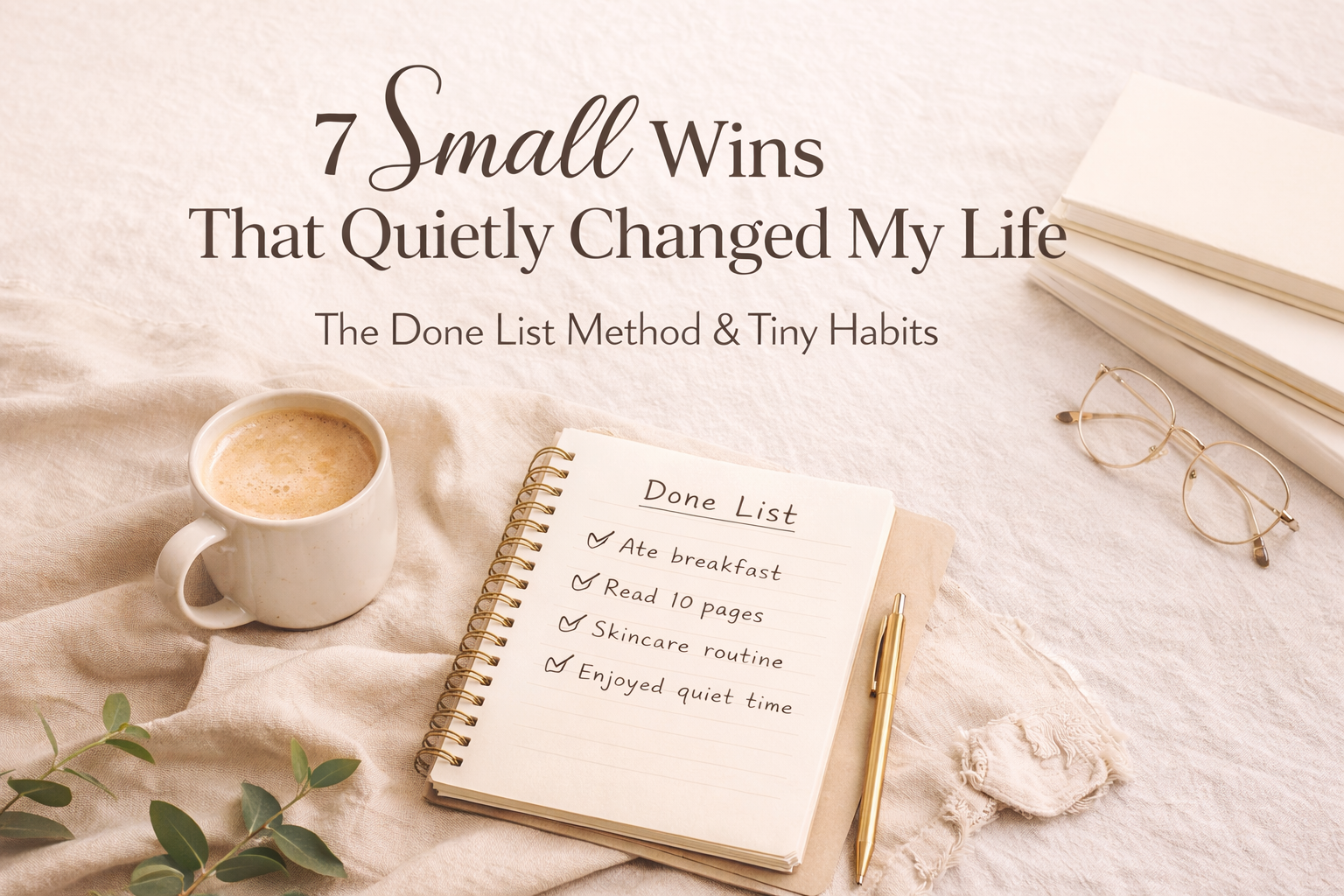
7 Small Wins That Prove Change Is Already Done: The Done List Method, Habits, and a Calm Thursday Shift
A calm and grounded Thursday
Thursday has a specific energy.
It’s not the fresh-start optimism of Monday.
It’s not the exhaustion of Friday.
Thursday is where reality lives.
And today feels like the perfect moment to pause. It’s not to plan what should happen next. It is to notice what has already changed.
Not loud productivity.
Not hustle.
Not pressure.
Just a quiet realization that some habits are no longer goals.
They’re facts.
That’s exactly where the Done List Method begins.
When planning stopped working — and noticing started changing everything
For years, I believed that change required:
- strict routines
- discipline
- willpower
- and a lot of self-criticism
I made plans.
I wrote to-do lists.
I promised myself that this time I would stick to it.
And every time I failed, I blamed myself — not the system.
What I didn’t realize back then was simple:
I was always focused on what I hadn’t done yet.
That mindset keeps your brain in a constant state of lack.
And the brain hates that feeling.
What the Done List Method really is (and what it is not)
The Done List Method is not:
- pretending
- lying to yourself
- manifesting without action
It is a psychological reframe.
Instead of writing:
- “I will eat breakfast”
- “I should read more”
- “I need a routine”
You write:
- I ate breakfast this morning.
- I read today.
- I took care of myself.
Why it works:
- the brain accepts the past as truth
- identity forms faster than motivation
- resistance drops instantly
Once something feels already done, behavior follows naturally.
Done List Method – full explanation
Pinterest – habit inspiration
Facebook – CalmDone community
My first small win: breakfast (at 38)
Here’s something I say out loud now — and it still surprises me.
I’m 38 years old.
Until three days ago, I honestly couldn’t remember the last time I ate breakfast after waking up.
Not in my twenties.
Not in my thirties.
Maybe as a child.
Coffee? Always.
Running? Always.
Food? Never.
So I didn’t write:
“I will start eating breakfast.”
I wrote:
I ate breakfast this morning.
No pressure.
No perfect meal.
No rules.
And now —
👉 Day three. Still eating breakfast.
Because my brain already believes:
This is something I do.
Why small habits feel boring — and why they change everything
Small habits don’t impress anyone.
They don’t look good on social media.
They don’t feel dramatic.
They don’t give instant results.
But they do one powerful thing:
They calm the nervous system.
When a habit feels safe, the brain stops resisting.
The Done List Method removes:
- urgency
- guilt
- perfectionism
And replaces it with:
- consistency
- identity
- quiet confidence
The habit I forgot was once impossible: skincare
There was a time when washing my face in the morning felt optional.
If I even did it, it felt like an achievement.
Now?
The sequence is automatic:
- brushing teeth
- cleansing my face
- serum
- cream
- sun protection
No debate.
No effort.
And the funniest part?
I completely forgot this used to be hard.
That’s how habits settle in —
they stop asking for attention.
Done List thinking builds identity, not pressure
To-do lists ask:
Can you do this?
Done lists say:
This is who you already are.
That shift matters more than motivation ever will.
Because motivation fades.
Identity stays.
The habit that surprised me most: reading
Another realization hit me recently — and it stopped me in my tracks.
In the last year, I’ve read more books than in the previous 20 years combined.
And this month alone?
👉 I’m already on book number five.
With two small kids.
With work.
With real life.
I don’t “find time” to read.
I am a person who reads.
That identity came quietly — one page at a time.
How Done Lists work with real life (and kids)
This is important to say clearly:
This isn’t a child-free, aesthetic routine.
This is real life:
- interruptions
- chaos
- exhaustion
- unpredictability
Done Lists don’t demand perfect days.
They work because life is messy.
Some days the win is:
- eating breakfast
- reading one page
- washing your face
And that’s enough.
Why writing habits in past tense changes behavior
Language matters more than we realize.
“I will” = delay
“I should” = pressure
“I need” = resistance
“I did” = truth
“I am” = identity
“It’s done” = calm
When you write habits as already completed, the brain looks for proof — and creates it.
Thursday is for noticing, not pushing
Thursday isn’t about new goals.
It’s about noticing:
- what stuck
- what feels natural
- what no longer needs effort
Those are your real wins.
And Done Lists make them visible.
The hidden benefit: self-trust
The biggest shift wasn’t productivity.
It was self-trust.
Every small done habit sends a message:
I keep promises to myself.
That changes everything.
How to start your own Done List today
Keep it simple:
- Choose one tiny habit
- Write it in past tense
- Repeat it daily
- Do not add pressure
- Let identity catch up
Examples:
- I ate breakfast today.
- I read one page.
- I took care of my skin.
- I showed up calmly.
That’s it.
CalmDone Shop – Done List planners
Blog – habit building with calm
Change doesn’t announce itself
Real change doesn’t shout.
It whispers.
And one Thursday, you suddenly realize:
I’m already living differently.
Not because you forced it.
But because you let it happen — one small, done habit at a time.